Warsh warns super intelligence could cost jobs or bust stocks, not just boost growth
Opening the Fed's Productivity and Jobs Task Force conference, Chair Kevin Warsh laid out three staff scenarios for super intelligence, from broad gains to job displacement to a stock-market reversal.
Federal Reserve Chairman Kevin Warsh told a Fed conference on Monday that super intelligence could lift American living standards for years, but that it could also push U.S. unemployment above full employment or, if it disappoints, set off a stock-market slide and a slowdown. [1][2] Fed staff have begun modeling those outcomes, he said, stressing that they are "illustrative scenarios, not forecasts." [1]
Warsh spoke at the opening of the Productivity and Jobs Task Force Conference, his first visit to a regional Reserve Bank as chair. [1][2] He said the widespread use of the technology "will have significant impact on the economy, with important implications for monetary policy down the road." [1][2]
Three paths for jobs and growth
In the best case, Warsh said, super intelligence "leads to an increase in productivity and economic gains that are shared broadly across labor and the owners of capital," with real GDP growth running above its long-run average and the U.S. staying close to full employment. [1]
A second path keeps growth strong but hurts workers. That expansion "could bring substantial labor market disruption as some jobs are displaced, rather than complemented, by technology," and automation plus labor market frictions could push the jobless rate above full-employment levels, he said. [1]
The third path is a bust. "After significant capital investment and stock market gains, expected returns could turn down and equity valuations could fall, leading to an economic slowdown and a more notable rise in unemployment," Warsh said. [1][2] "In time, the economy would recover, but without the productivity gains." [1][2] That risk reaches American savers directly: the prospect of AI advances has already driven stock market valuations higher, CNBC noted. [2]
Why productivity matters to the Fed
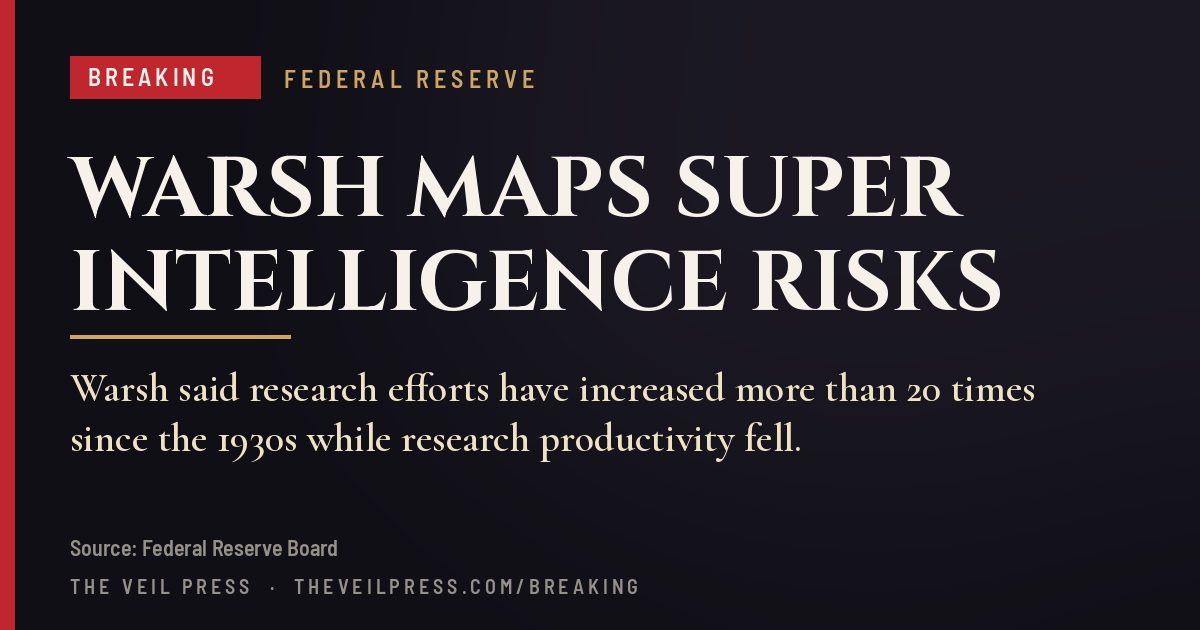
Warsh said productivity growth has been "reasonably strong" in recent quarters but "hasn't yet broken out definitively and structurally to the upside." [1] He pointed to research showing that research efforts in the U.S. have increased more than 20 times since the 1930s, even as research productivity fell. [1] Super intelligence might be different from electricity or the internal combustion engine, he said, because "it could supercharge idea generation." [1]
Since taking the job, Warsh has argued that the technology can raise productivity and act as a disinflationary force, CNBC reported. [2] He used the term "super intelligence" rather than artificial intelligence, in line with the president's recent order that the government use that term almost exclusively. [2]
He kept the Fed's own role narrow. "At the Fed, our role in all this is neither advocacy nor opposition," he said. [1] He added that policymakers should not underestimate people: "Humans are the designers and the builders, and humans must be the deciders." [1]
The task force
The Productivity and Jobs group is one of five task forces Warsh announced in July, alongside panels on communications, balance sheet policy, data and inflation frameworks. [3] Its leaders are Marc Andreessen, a cofounder of the venture firm Andreessen Horowitz; Stanford economist Charles I. Jones; and Asha Sharma, an executive at Microsoft. [3] The task forces are to work independently, supported by Fed staff, and produce findings for the Federal Open Market Committee. [3]
What comes next
The conference closes with a fireside chat featuring Warsh alongside task force leader Marc Andreessen, according to CNBC. [2] The task force's findings will go to the Federal Open Market Committee, the Fed's rate-setting panel. [3]
What we know
Confirmed
- Warsh outlined three staff scenarios and called them "illustrative scenarios, not forecasts." [1]
- The task force is one of five he announced in July. [3]
Still being reported
- How the scenarios will shape future rate decisions. [2]
Sources
- Primary Opening Remarks by Chairman Kevin Warsh at the Productivity and Jobs Task Force Conference (Board of Governors of the Federal Reserve System, 2026-11-16)
- Reported Fed Chairman Kevin Warsh stresses importance of AI to economy, but says it could 'disappoint' (CNBC, 2026-11-16)
- Primary Federal Reserve announces the leadership and objectives of its task forces to advance the conduct of monetary policy (Board of Governors of the Federal Reserve System, 2026-07-09)
Breaking newsMore storiesThe Veil Press
Get your breaking news from us.
What happened, what it means for you, and who benefits. Every claim sourced, with the confirmed facts separated from what is still being reported.
See all breaking news From the LibraryThe Veil of the Square Mile, Vol. IGet the book →
Republish this story
Free to republish in full with credit, under CC BY-ND 4.0. Keep the byline and the link back to this page.
CopiedShare this story
Link copied