Archived breaking story from October 27, 2026. This link will not change. Browse the archive.
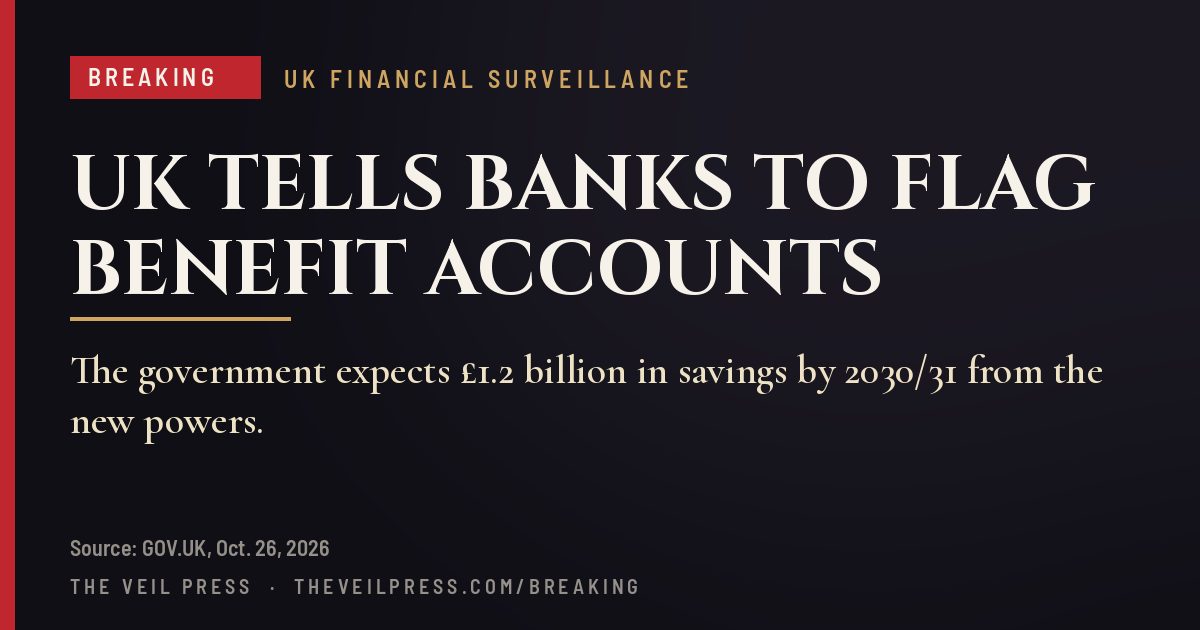
UK Orders Banks to Flag Benefit Claimants' Accounts in First Use of New Fraud Powers
The Department for Work and Pensions has issued its first Eligibility Verification Notice, a legal demand that banks check benefit accounts against eligibility rules.
What happened
In Britain, the Department for Work and Pensions (DWP) announced on Monday, October 26, 2026 that it has sent its first Eligibility Verification Notice, a legal demand that banks hand over information so officials can test whether people still qualify for the benefits they receive [1]. Banks are being asked to spot claimants who may be sitting on savings they did not declare, or who have stayed overseas longer than the rules permit [1]. Ministers expect the scheme to save £1.2 billion by 2030/31 [1].
The authority comes from the Public Authorities (Fraud, Error and Recovery) Act 2025 [1]. Only three programs are covered: Universal Credit, Pension Credit and Employment and Support Allowance [1]. The government puts the yearly cost of this kind of fraud and error, in the first two programs, at £1.5 billion for 2025-26 [1].
The department says the powers "do not give DWP access to people's bank accounts, transactions or spending habits," and that a flag is not an accusation of fraud [1]. It adds that no entitlement decision can rest on the bank data alone, and that the scheme starts as a "test-and-learn phase" with independent oversight [1].
How it affects Americans
The United Kingdom is America's closest financial partner, and this is a live example of a government compelling banks to screen customer accounts against eligibility rules. American readers have a stake in the precedent: the same tools and arguments surface in U.S. debates over bank reporting, benefit integrity and who gets to look at a household's accounts. Anything that normalizes routine screening of ordinary accounts abroad becomes a reference point for proposals at home, and for the banks that operate on both sides of the Atlantic.
The Veil Press view
Fraud against taxpayers is a real problem, and the £1.5 billion figure shows the scale [1]. But a government that orders banks to scan the accounts of the people it pays has taken a step that deserves scrutiny, whatever the safeguards promised. The official line is that no bank account access is granted and that a flag proves nothing [1]. Those assurances rest on a code of practice and a trial period, not on a limit written into the principle. Limited powers have a way of widening once the machinery exists. The sound approach is the narrow one: real penalties for real fraud, with strict limits on what banks can be made to report about their customers.
What we know
Confirmed
- DWP has sent its first Eligibility Verification Notice to banks [1].
- The government projects £1.2 billion in savings by 2030/31 [1].
- The power covers Universal Credit, Pension Credit and Employment and Support Allowance [1].
- The government puts related fraud and error in Universal Credit and Pension Credit at £1.5 billion for 2025-26 [1].
Still being reported
- None.
Sources
- Primary Government unleashes £1.2 billion crackdown as part of anti-fraud drive (GOV.UK (Department for Work and Pensions), 2026-10-26)
Breaking newsMore storiesThe Veil Press
Get your breaking news from us.
What happened, what it means for you, and who benefits. Every claim sourced, with the confirmed facts separated from what is still being reported.
See all breaking news From the LibraryThe Veil of the Square Mile, Vol. IGet the book →
Republish this story
Free to republish in full with credit, under CC BY-ND 4.0. Keep the byline and the link back to this page.
CopiedShare this story
Link copied