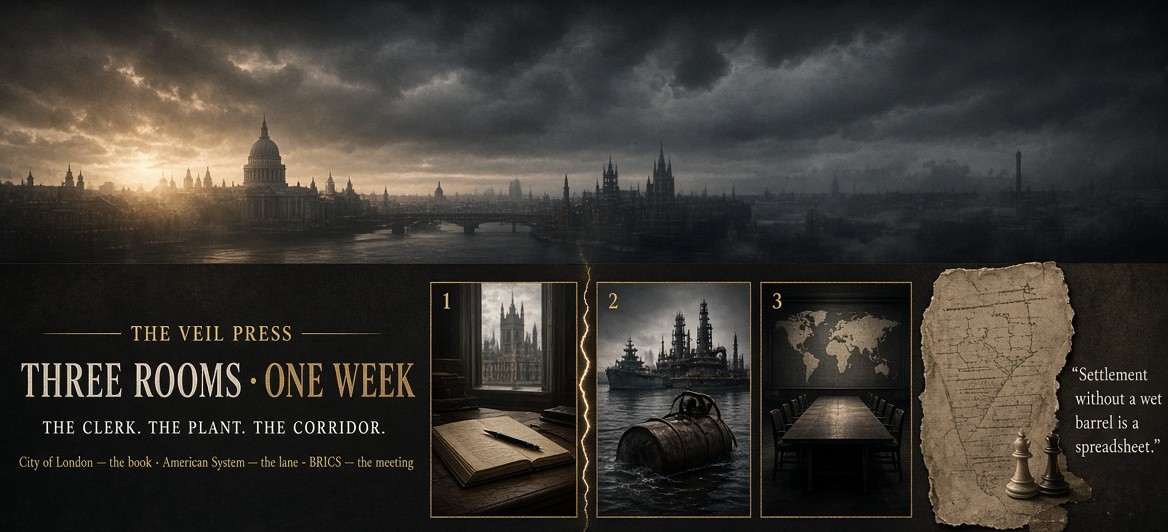
Three Rooms, One Week
Strait of Hormuz, Caracas, and a Bishkek summit are three bids to decide who writes the next settlement layer of the world. They are not morally the same.
Three rooms, one week
This week the war is being fought in three rooms at once.
In the Strait of Hormuz, the United States hit Iranian launchers on Larak Island after Tehran tried to put more mines in the lane. Iran fired back at American positions in Jordan and the UAE. First exchange in a month.
In Caracas and Washington, Trump announced a deal that would give the United States majority control of about 65 billion barrels across seventeen Venezuelan fields. He said it would refill the Strategic Petroleum Reserve and bring the pump down. The reserve is already at its lowest since 1982. The paper is thin. The meaning is not.
In Bishkek, Xi Jinping, Vladimir Putin, and Narendra Modi sat down at the Shanghai Cooperation Organization summit with Iran's president in the room. Security, trade, energy, and "financial cooperation architecture" while the strait is still a wound.
Those are not three stories. They are three bids to decide who writes the next settlement layer of the world. And they are not morally the same.
The clerk is not a neutral machine
The City of London system is not a flag and it is not an ethnicity. It is a habit of power that treats nations as counterparties and human beings as residual.
For a century a great deal of the world's oil has been priced, hedged, and insured in a market that grew up around that square mile — Brent on the ICE book, marine war risk at Lloyd's, trading floors that book far more barrels than the companies lift. BP and Shell still run global trading out of London. When a strait closes, the first number that jumps is often the insurance slip. Lloyd's is still writing Hormuz cover. War-risk rates have multiplied. That is rent on the hour between the well and the tank.
Call that what it is. Not competence. A moral structure. The City system does not need your country to prosper. It needs your cargo to remain a contract that must ask a clerk for a price and a policy. Wars can be weather. Famines can be weather. A closed strait can be a banner year for the desk. European majors' trading arms were already on course for a fat year off the Iran war before this week's new shooting. Production is one business. Harvesting chaos is another.
That is why the British system is corrupt at the root. Not because Englishmen are uniquely wicked. Because the operating principle is extraction without duty — profit detached from the soil, the plant, and the family that has to live with the bill. A republic can be brutal. This system is something colder. It does not even have to occupy you. It just has to own the stamp on your barrel.
The American system is not that animal
The American system, in the older sense, is not angelic. It bombs. It cuts deals with ugly partners. It is late and loud. It is still a different creature.
It wants the barrel as feedstock and the sea lane as a navy problem. Plants. Freight. A reserve you can actually draw. This week's version is crude and visible. CENTCOM says American forces have moved hundreds of millions of barrels through the strait under protection while Iran's own exports sit at zero under blockade. Bessent is promising weekly hits on banks that still touch Tehran — "financial violence." The Venezuela paper is the hemisphere half of the same idea: if Hormuz is a fight, lock heavy-sour crude next to the Gulf Coast cokers built to run it.
That can go wrong. A hundred-year concession hat is an old imperial costume, and energy historians have already reached for BP in Iran and Iraq as the ancestor. Fair warning. The distinction still holds. One system asks whether an American plant runs and an American family can buy diesel. The other asks whether the book still clears in the same rooms no matter who dies on the water. Those are not the same moral question.
NPR is right that the Venezuela deal will not drop gasoline this month. Proven rock is not a cargo. The signal is still industrial: the United States is trying to pull a feedstock out of a clerk's market and put it back into iron. That is not beastly. That is a country remembering it used to make things.
BRICS without the barrels
The third room wants an exit from the clerk and does not have the parts.
CIPS has grown. mBridge has processed tens of billions, overwhelmingly in digital yuan after the Bank for International Settlements walked away. BRICS Pay is slated for the New Delhi summit in September — a stitch of Russia's SPFS, China's CIPS, India's UPI, Brazil's Pix. Local-currency talk is real. A single reserve currency is not. IMF data still shows the dollar in the vault. Indonesia and the UAE keep both tracks open.
Here is the material problem they will not put in the family photo. Without Iran's Gulf position and without Venezuela's heavy crude, the bloc is a corridor with a hole in it.
Iran is the choke on the old lane. Venezuela is the largest proven stockpile on the map and the grade that matches a certain kind of refinery. This week the United States is blockading one and signing paper on the other. That is not a sideshow. That is BRICS getting neutered at the wellhead while the summit discusses payment architecture. You cannot replace the clerk with software if you do not have the molecule or the navy that moves it.
Russia can sell discounted oil to India. China can clear yuan. India can run UPI. None of that opens Hormuz if CENTCOM says no, and none of it lifts Orinoco if Washington holds the gate. Settlement without a wet barrel is a spreadsheet.
The alliance that cannot pray together
There is a second problem, and it is not polite.
BRICS is not a civilization. It is a coalition of leftovers from the clerk's world who do not trust each other enough to become a people.
Russia is the only major Christian state in that room — Orthodox, wounded, still talking in the language of nation and church even when the state is ugly. China is a communist party that will use churches and mosques as inventory. Iran is a revolutionary Islamic republic that just told Gulf rulers to name their "real enemy." India is a Hindu-majority democracy with its own memory of Islamic conquest and Chinese pressure. Brazil and South Africa add still other gods and other grievances.
That mix can sign a communiqué. It cannot decide what a good life is. When the shooting starts, men do not die for CIPS. They die for a cross, a flag, a book, or a party. An uneasy pile of Christian, communist, Muslim, and Hindu interests will hold as long as the clerk is the common enemy. The minute the clerk is weak enough to loot, they will loot each other. Modi sitting with Pezeshkian to talk stranded Indian sailors is not communion. It is a shopping list. India still needs a working strait and a working dollar window. It is in the photograph. It is not all-in on a yuan church.
The City system exploits that. It always has. Managed conflict is easier when the other table cannot agree what "we" means.
The American system has its own fractures. It also has a usable core: a Christian-formed republic, a continental plant base, and a navy that still exists. That core is damaged. It is not imaginary. That is why Washington can move a fleet and a sanction list in the same week while Bishkek issues language about connectivity.
Who wins a three-faction war
If you want a scoreboard, skip the 65-billion-barrel number and skip the summit portrait.
Watch whether Gulf Coast units actually run Venezuelan heavy. Watch whether Lloyd's and the London desks keep collecting rent on every cargo that still has to move. Watch whether BRICS Pay in September clears real trade at scale, or remains a settlement layer leaning on the dollar for the reserve and on London for the wet barrel.
The City system ends the day it stops being the default clerk. It deserves to end. Not because a summit said "multipolar." Because a world that prices human work as a chip in someone else's book is rotten.
BRICS is trying to build the exit in software and in a coalition that cannot name a common God. The American system is trying to build it with a fleet, a bank war, and a well in its own hemisphere. That is ugly work. It is still closer to a country than to a casino.
This week the fleet is moving. The well is on paper. The summit is talking. The clerk is not dead. He is just no longer the only man in the room — and the room that can still act like a nation is outplaying the room that can only act like a meeting.